

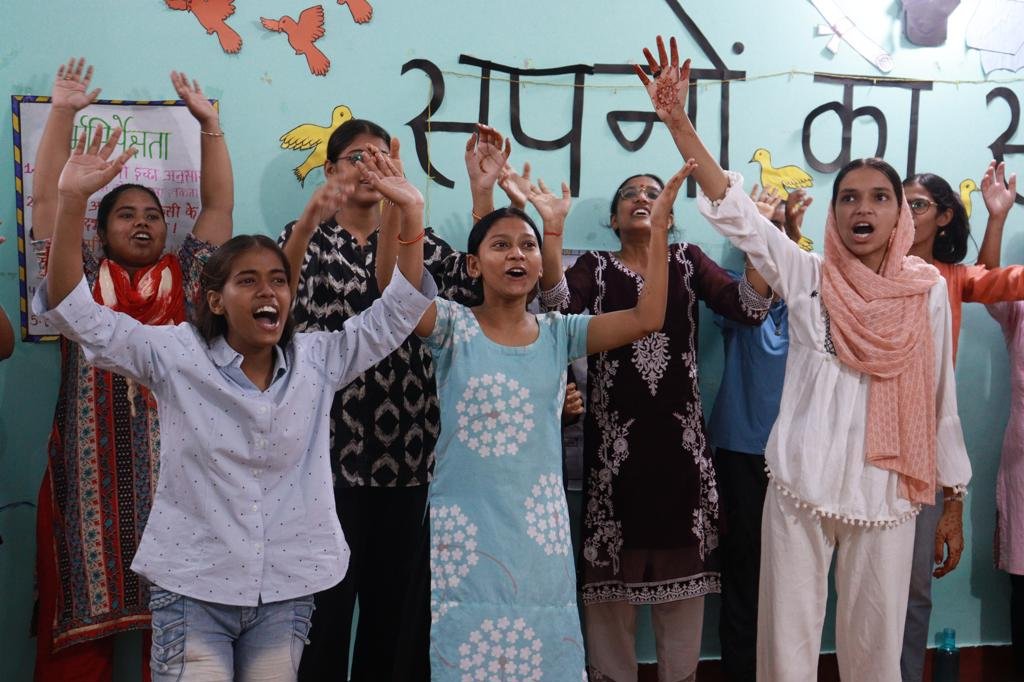
A reflective programme note from Program Officer – STEM and Livelihoods, Govind Rathod and Program Officer – Trauma-Informed Fellowships, Bhawna Rawat, Protsahan, on what success looks like when the unit of measurement is not output, but agency.
Why is “fellowship” the right word?
Most programmes that work with adolescent girls and young women from urban poverty describe themselves in a certain language. Skilling. Placement. Vocational training. The vocabulary is functional, but it carries a quiet assumption that the girl’s life is missing a skill, and once the skill is delivered, the gap is closed.
We have come to believe this is the wrong frame.
What is missing in the lives of the young women we work with is not a skill. It is the conditions in which a young woman can imagine herself as an agent of her own life and then, slowly and with support, act on that imagination. The deficit is not technical. It is structural, emotional, social, and very often, deeply personal. A skills programme alone cannot address it. A fellowship can.
Protsahan’s Trauma-Informed Fellowships work with girls and young women aged 17 to 25 from migrant families across the slum clusters of Delhi households held together by daily wage labour, construction, vegetable vending, rickshaw pulling, factory work, and domestic work. Most of the girls we engage are first-generation learners. Most carry, alongside the structural weight of poverty, the more private weight of trauma, bereavement, eviction, domestic violence, early loss of safety, and early loss of choice.
A fellowship is not just a curriculum. It is a held space. Held over time. Held by trained mentors. Held by other young women who have walked the same path one or two years ahead. Within that holding, a young woman can begin to build the architecture of an adult life on her own terms through whichever pathway turns out to be hers.
The pathways — not just the destination
Trauma-informed fellowships are deliberately pathway-agnostic. The fellowship’s job is not to deliver a girl to a predetermined endpoint. It is to support her in discovering her own.
In practice, our fellows take one or several of the following paths, often moving between them as they learn what fits.
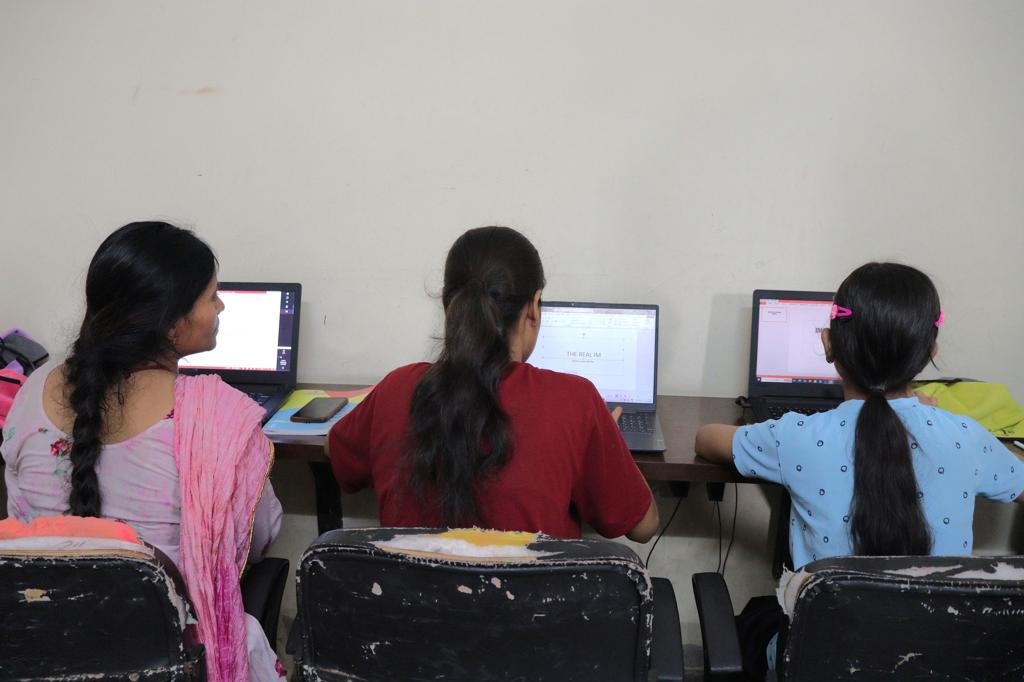
Higher education. For most fellows, this is the first crack in a generational wall. From college admissions counselling and scholarship support to laptop provision and continuity coaching, the fellowship walks alongside a girl through the actual structural friction that causes most first-generation learners to drop out. Pinki’s Bachelor of Computer Applications at IGNOU sits in this lane.
Internships and exposure. First-time visits to corporate offices, NGOs, and creative studios. Mock interviews. Workplace etiquette is held with curiosity rather than shame. For most fellows, the first internship is the first time they have been treated, in a professional setting, as a colleague rather than a helper. That single shift in social register is, on its own, a measurable outcome.
Formal employment. Young women like Reshma, who today works the front desk at an international chain of hotels a graduation that began with art-based therapy years earlier and travelled, step by step, through fellowship, mentorship, mock interviews, and hospitality readiness training.
Micro-entrepreneurship. Fellows like Komal, running her handmade-bag business Moon Tara on Instagram, with over 40 sales and active market research underway and Rani, with three years of Lippan and Madhubani art, are now moving from community stalls toward an online presence. The fellowship offers digital skills, business planning, social media strategy, and emotional support when the journey gets bumpy (cyberbullying, family pushback, inventory anxiety).
Community leadership and peer-mentoring roles. Fellows who go on to lead Convergence Camps in their own bastis, run linkage drives, facilitate community dialogues, or step into the Girl Champion Fellowship as next-cohort mentors. This is the pathway through which the work scales without being scaled industrially.
The point is not which pathway. The point is that all five pathways rest on the same prior outcome: agency.
What agency actually looks like (and why it is hard to measure)
The single hardest question in our MEL practice is not how to count enrolments or placements. It is how to measure agency.
Agency does not arrive as a single observable event. It accretes. It shows up in micro-decisions a fellow may not even recognise as decisions:
- the first time she travels alone on the metro to a session
- the first time she opens her own bank account and decides where her own earnings go
- the first time she says “मुझे थोड़ा वक़्त चाहिए” I need some time, to a marriage conversation at home
- the first time she sets a price for her own work and holds it
- the first time she walks into a bank, a college admissions office, a government linkage portal as the person doing the navigating, not the person being navigated for
- the first time she disagrees with a mentor in a session and is met with welcome instead of rebuke
- the first time she chooses to stay in education rather than leave it for a wedding date
None of these are line items in a logframe. All of them are agency.
We have learnt, over years of working with this population, that agency is best tracked through observable behavioural shifts across three domains and we offer this as our working framework, in the spirit of sectoral exchange.
Domain one — agency over the body and daily mobility. Schedule. Voice in household decisions. Refusal of routine violence. Ability to say no to small things, which is the precondition for being able to say no to large things.
Domain two — agency over money and skill. Bank account in her own name. Decisions about where her earnings go. The shift from passive recipient of household financial decisions to active participant. Acquisition of skills she chose, not skills imposed on her.
Domain three — agency over the future. Articulation of her own goals in her own words. Active choice about education, marriage, career, and fertility timing. Capacity to imagine futures that do not yet exist in her family’s lived memory.
A fellow who is moving across these three domains even slowly, even unevenly, is moving in the direction the fellowship was designed to make possible. A placement number alone cannot tell us this. A trajectory mapped across these three domains, observed over the eighteen to thirty-six months a fellowship typically holds, can.
Khushboo’s journey: when healing is the first measurable outcome
The MEL spine of any programme is only as honest as the lives it can actually account for.
द्वारका की झुग्गी बस्तियों की संकरी गलियों में, जहाँ सपनों को साँस लेना भी मुश्किल हो जाता है, in the narrow lanes of Dwarka’s slum clusters, where dreams find it difficult even to breathe.
Twenty-year-old Khushboo and her family had come from Khagaria district, Bihar, in search of work that did not exist back home. They are an OBC family, and Delhi was supposed to be the chance their village had not given them.
The first home they built in Harinagar’s basti was demolished because it stood at the edge of a road. The eviction did not just take the house. It took her father, who, unable to bear the shock of homelessness and the weight of mounting debt, took his own life. The family relocated to a small rented room in the slums of Dwarka Sector 16A. The responsibilities of the household fell onto Khushboo’s young shoulders. She found work in a factory, packing purses. The economic and emotional weight pushed her, at one point, into thoughts of ending her own life.
It was at this point that she reached out to Protsahan.
She entered our trauma-informed care pathway first, counselling, psychosocial support, and the slow work of stabilisation. From there, she enrolled in the fellowship. Step by step, she has been finding her ground. She is now actively engaged in financial literacy, digital learning, and personal development sessions.
She has not yet arrived at a destination. The fellowship is not designed to deliver one on a fixed timeline. What she has, instead, is direction and the language to describe it for herself. She speaks now of building a better future for herself and her family. निराशा से आशा तक, मौन से आत्मविश्वास तक, from despair to hope, from silence to self-belief.
Khushboo’s case demonstrates a methodological point we want the sector to take seriously: the first measurable outcome of a trauma-informed fellowship is sometimes simply a young woman’s continued aliveness, stabilisation, and re-entry into the imagining of her own future. That outcome will not appear in a placement count. It will appear in everything that becomes possible because of it.
Rani: When the family is not yet ready
Eighteen-year-old Rani came to the fellowship from a migrant family from Alwar, Rajasthan, a Kumhar (OBC) household of six, where her father practises traditional pottery and where Rani continues to navigate domestic violence from her father and grandmother.
When she joined Protsahan, she was in Class 12. We supported her with a higher education scholarship, counselling, self-development sessions, digital skills training, and confidence-building work. Alongside her studies, Rani has spent the last three years making art, photo frames, Lippan art, and Madhubani paintings, which she sells in her local community and at small stalls. She is now building her presence online to reach a wider market. While doing so, she encountered cyberbullying. Through the fellowship’s counselling support, she worked through the fear it had introduced and is rebuilding her digital presence on her own terms.
Her family still does not endorse her ambitions. This is part of the data, too.
Empowerment work does not always end in family endorsement. Sometimes it ends, for a long while, in a quiet, daily refusal to give up. Rani’s case reminds us that a fellowship’s success is not contingent on the speed of household change. It is contingent on the durability of her own resolve, and our job is to keep building the scaffolding that holds that resolve up while the household catches up at its own pace.
Komal: An integrated outcome
Nineteen-year-old Komal is a Girl Champion from Bhagalpur, Bihar. She lost her father in a workplace fire when she was six months old. The family has lived on a monthly pension from his employer, supplemented by the invisible labour her mother performs at home, and the futures her three siblings are still building.
Komal joined the fellowship five months ago and has just enrolled in B.A. (First Year) at the School of Open Learning, Delhi University. Alongside her studies, she has built Moon Tara, her handmade fabric bag business using traditional pearl techniques. She began selling at college events and local markets. After fellowship sessions on digital skills, business planning, and social media marketing, she set up the Instagram presence, has sold over 40 bags, and is now conducting market research to refine her products.
Komal’s case maps onto multiple agency domains at once: agency over money and skill (running her own enterprise), agency over the future (higher education enrolment, articulated business strategy), and the early architecture of community leadership through visible entrepreneurship. This is what an integrated agency outcome looks like when the fellowship is doing its job.
Pinki: When material inputs are constitutive
Nineteen-year-old Pinki migrated with her family from Ayodhya, Uttar Pradesh, and now lives in a slum settlement in Shiv Vihar. She has completed Class 12 from CBSE. Her father is neither financially supportive nor encouraging of her education, and is often violent towards Pinki and her mother after drinking. Her mother, a thyroid patient, runs a small shop. The household’s monthly income is between ₹3,000 and ₹4,000.
Pinki joined Protsahan in 2024 and attended digital and financial literacy sessions through the fellowship. Something clicked. She discovered that what she actually wanted to do was work with computers.
To make that pathway viable, the fellowship provided her with a laptop. She is now pursuing a Bachelor of Computer Applications from IGNOU University and supporting her household through participation in linkage camps in her own slum community.
We share Pinki’s case to make a methodological point that often gets lost in romantic readings of empowerment work. Trauma-informed fellowships are not only emotional and pedagogical interventions. They are, sometimes, deeply material: a laptop, a scholarship, a transit pass, a single document that opens a door that has been closed for two generations. The fellowships that pretend agency can be built without these inputs are not being honest about how poverty actually works.
What the cases tell us about how to measure
Looking across Khushboo, Rani, Komal, Pinki, and Reshma, four MEL insights carry forward.
One — The unit of measurement is the trajectory, not the moment. A fellow’s enrollment, her first salary, her first solo metro journey, her first declined marriage conversation, these are points on a curve. Single-point indicators flatten the curve. A trajectory-based MEL framework, mapped against the three agency domains and observed over the life of the fellowship, respects what is actually happening.
Two — Pathways are interchangeable. Agency is not. A fellow may move from internship to micro-entrepreneurship to formal employment to higher education in any sequence. What is not interchangeable is the underlying agency that allows her to navigate any of those pathways at all. Programmes that report only on placement numbers are tracking the surface and missing the substrate.
Three — Healing is the precondition, not a parallel track. Khushboo’s story is the clearest illustration. No skills curriculum could have reached her in the state she came to us in. Counselling and stabilisation were not soft pre-work. They were the load-bearing infrastructure on which every subsequent input was eventually able to rest.
Four — Material inputs are constitutive. A laptop, a scholarship, and a cyberbullying recovery support session that allows a young woman back into her own digital life. The fellows are not asking for charity. They are asking for a few specific resources that turn an aspiration into a viable plan.
Why this matters beyond the fellowship
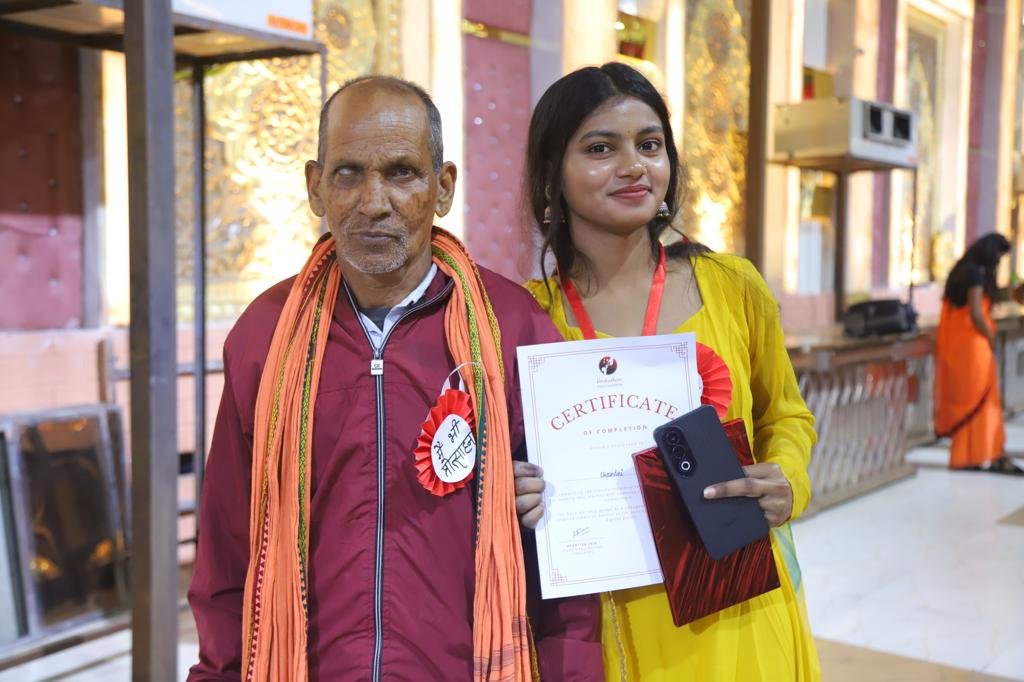
When a first-generation migrant family’s daughter prepares for a mock interview, opens a bank account in her own name, sets a price for her own art, or enrols in higher education, what is happening is not only personal advancement. It is the slow, generational rewriting of who is allowed to imagine a future from her address.
Each of these journeys breaks a cycle. Each changes what younger cousins and neighbours’ daughters now believe is possible from their own basti. Each puts gentle, durable pressure on a community’s expectations of where a girl belongs, what she is allowed to want, and how loudly she is allowed to want it.
This is what we mean by systems change at the last mile. Not a top-down policy shift. A bottom-up rewriting of the local culture of possibility, one girl champion at a time.
Success, for a trauma-informed fellowship, is not just a placement number. It is the slow accretion of agency in a young woman’s life — observable in how she moves through the world, how she names her own future, and how she carries herself when no one is counting.
We measure what cannot be counted by learning, patiently and rigorously, to read it well.
This programme note draws on case data from Protsahan’s Trauma-Informed Fellowships. Names of fellows have been retained with consent. The three agency domains are agency over the body and the daily, agency over money and skill, and agency over the future, which anchor the fellowship’s MEL framework alongside pathway outcomes in higher education, internships, employment, micro-entrepreneurship, and community leadership.