
A reflective programme note from Program Officer – STEM and Livelihoods, Govind Rathod, from Protsahan on the Digital Inclusion & Government Linkages Camps for migrant families across Delhi slums.
Why Convergence Camps?
In Delhi’s slum clusters, the distance between an entitlement and the family it was designed for is rarely measured in kilometres. It is measured in missing documents, intermediary fees, lost workdays, and the quiet exhaustion of being told to “come back tomorrow.” For migrant families from Uttar Pradesh, Bihar, Rajasthan, Haryana, Jharkhand and West Bengal — many of whom hold the city up through informal labour — that distance is the difference between social protection and structural neglect.
Protsahan’s framework rests on three interlocking pillars: rescue, continuum of care, and linkages. Without social protection, child protection cannot hold. A girl from an ultrapoor migrant family whose mother has no Maternity Benefit, whose father has no E-Shram cover, whose household has no ration entitlement, is a girl whose safety net is conditional on a permanent crisis economy. The Convergence Camps were designed to address the linkages pillar directly — closing the documentation gap that locks economically vulnerable families out of schemes designed precisely for them. These camps have a structured quarterly cadence but for the scope of this learning note, I draw on field data from Convergence Camps held at four sites across West Delhi between October 2024 and January 2025.
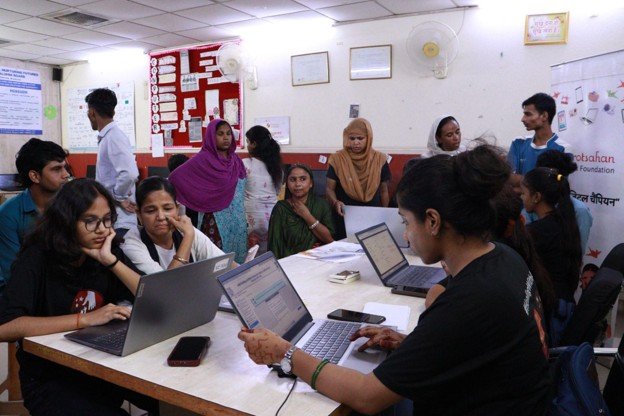
Between October 2024 and January 2025, Protsahan held Convergence Camps at four strategic locations across West Delhi’s slum clusters, supporting thousands of migrant families with E-Shram cards, Income Certificates, PAN cards, Voter IDs, bank account openings, and onward linkages into schemes such as Pradhan Mantri Matru Vandana Yojana.
The Programme Theory: Why Hyperlocal Girl Leadership
The most distinctive choice in the design was who would lead.
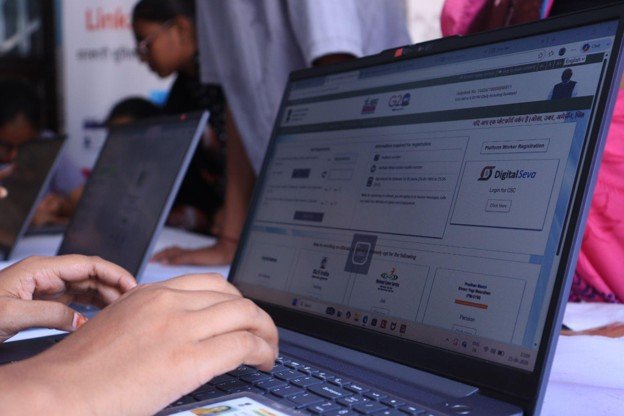
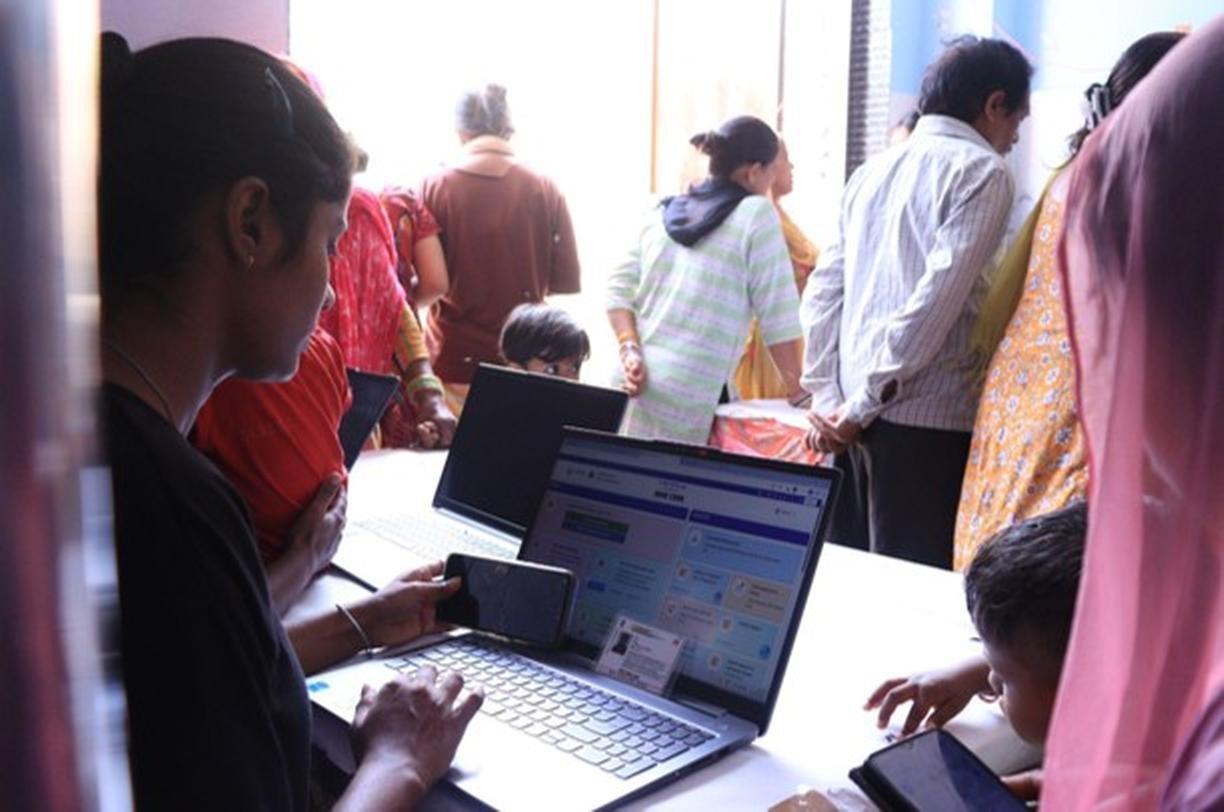
Fifteen Youth Peer Leaders who are erstwhile alumni from Protsahan’s Girl Empowerment Programmes were trained to operate the government linkage portals themselves. They became the front-line workforce of the camps — sitting at the laptops, opening the portals, walking aunties and uncles through Aadhaar verification, troubleshooting OTPs, completing applications on behalf of families.
This was a deliberate design choice, not a logistical convenience. Three reasons grounded it.
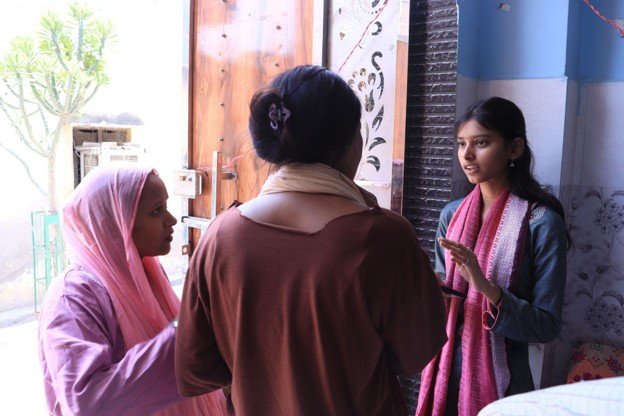
First, hyperlocal trust. Migrant families are accustomed to being misled at the cost of ₹500, ₹1,000, ₹3,000 by middlemen who offer to “make” their documents. A girl Youth Peer Leader (YPL) from the same gali, whose mother they recognise from the lane, breaks that trust deficit faster than any external facilitator can.
Second, gendered access to digital systems. In communities where cyber cafés and digital documentation work are visibly male-coded, girls operating the laptop on behalf of families is itself an intervention — not just in service delivery, but in the unspoken story of who gets to hold the keyboard.
Third, the trauma-informed continuum. Many of these girls had walked through Protsahan’s H.E.A.R.T. healing pathway. Leadership at the Convergence Camps was not an entry point. It actually feels like the final dissertation of a four-year degree course, we’ve been told! The work itself is therapeutic insofar as it returns agency, competence, and visibility to young women who have spent years being told they belong elsewhere.
What the Data Told Us About Unlocking Agency
The MEL framework for the Convergence Camps tracked outputs at three levels: documentation completed, scheme linkages enabled, and shifts in household-level digital agency. The patterns were consistent across the four sites.
The documentation gap was not random. It clustered around three predictable failures: (1) Income Certificates, where families had previously paid intermediaries between ₹2,000 and ₹3,000 for a free service; (2) E-Shram registration, where awareness of the scheme was high but pathways to enrolment were absent; and (3) bank account openings for women, blocked by combinations of address proof and KYC mismatches that no household had the bandwidth to resolve alone.
A migrant industrial worker at the Uttam Nagar camp put the cost differential plainly:
“हम अपना आय प्रमाण पत्र बनवाने गए थे, और वे ₹3000 मांग रहे थे। यहाँ, यह महत्वपूर्ण दस्तावेज़ बिना किसी लागत के बनाया गया। यह हमारे जैसे परिवारों के लिए बहुत बड़ी राहत है।”
We had gone to get our Income Certificate made, and they were asking for ₹3,000. Here, this critical document was made at no cost. For families like ours, this is an enormous relief.
Behind that single line sits a sectoral pattern Protsahan has documented for years: poverty is taxed twice — once by the absence of an entitlement, and again by the cost of accessing it.
The scheme-linkage pathway also revealed a strong cascade effect. A single E-Shram card opened the door to onward eligibility for several other entitlements families had not previously been able to access. Ashok, a construction worker from Dwarka, described the chain reaction in the lives of his own family:
“मेरी पत्नी गर्भवती थी, और हम ई-श्रम कार्ड न होने के कारण मातृ वंदना योजना के लाभों का लाभ नहीं उठा पा रहे थे। प्रोत्साहन और इस शिविर के लिए धन्यवाद, हम अपने सभी दस्तावेज़ व्यवस्थित करने में सक्षम थे।”
My wife was pregnant, and because we had no E-Shram card, we could not access the benefits of the Matru Vandana Yojana. Thanks to Protsahan and this camp, we were able to get all our documents in order. Now we can finally access the government services we need.
This is what the continuum of care looks like in practice. Maternal entitlement, child nutrition, and household stability sit downstream of one missing card.
The Quiet MEL Indicator: Who Holds the Keyboard
Some of the most important shifts the Convergence Camps produced will not appear in the documentation count. They appear in a different indicator we have learnt to track over time — who, in the household, is now seen as the person who can navigate a system.
A migrant domestic worker at the West Delhi camp said something we have heard, in different words, at every site:
“मैंने हमेशा लड़कों को साइबर कैफे या अन्य जगहों पर डिजिटल रूप से काम करते देखा है, जबकि पहली बार यहाँ लड़कियाँ ये कंप्यूटर पर डॉक्यूमेंट बना रही हैं।”
I have always seen boys doing digital work at cyber cafés and other places. This is the first time I am seeing girls making documents on the computer.
A Girl Champion’s mother, watching her daughter at the workstation, put it more intimately:
“मैंने अपनी बेटी को पहली बार कंप्यूटर से पहचान पत्र बनाते देखा। मुझे यकीन नहीं हो रहा था कि वह कंप्यूटर चला सकती है और सरकारी कागज बना देगी, क्योंकि घर पर तो ये सारे काम मेरा बेटा करता है!”
I saw my daughter making an identity card on the computer for the first time. I could not believe she could operate the computer and produce government papers — because at home, my son does all this work!
This is data. It is just not the kind that fits inside an output column. It is the data of a household quietly revising who, in the next generation, is allowed to be competent in public.
Insights for the Sector
Five learnings carry forward from this round of Convergence Camps, and we offer them in the spirit of sectoral exchange rather than self-report.
One — Linkages work is gender-justice and mental health work. The persistent invisibility of women in formal documentation systems (no bank account in her own name, no E-Shram, no Aadhaar address linkage updated post-marriage) is a structural gap. Closing it changes the bargaining position of the household in terms of access to justice and care through entitlements.
Two — Last-mile linkage is cheaper than re-rescue. The cost of preventing a family’s slide into deeper precarity through one camp day is a fraction of the cost of any downstream rescue intervention. Funders treating linkages as “soft” outputs are missing the prevention economics of the work.
Three — Hyperlocal facilitation outperforms external facilitation on trust-dependent transactions. The girls running the workstations are not standing in for a government employee. They are doing something a government employee structurally cannot do — operate inside the household’s own social fabric.
Four — The trauma-informed lens belongs in livelihood work too. Documentation visits are not neutral encounters. They surface old anxieties about identity, displacement, and being seen by the state. A facilitator who has been trained in H.E.A.R.T. principles holds that room differently than one who has not.
Five — Digital inclusion is a feminist intervention before it is a technological one. Girls operating the keyboards in front of their own communities is the first chapter. The longer book is what those communities now expect of their daughters.
The work remains, in the end, what it has always been at Protsahan. Not transactional. Not extractive. A slow, careful return of agency to the families and the girls who were never supposed to have to fight this hard for what was already theirs.