

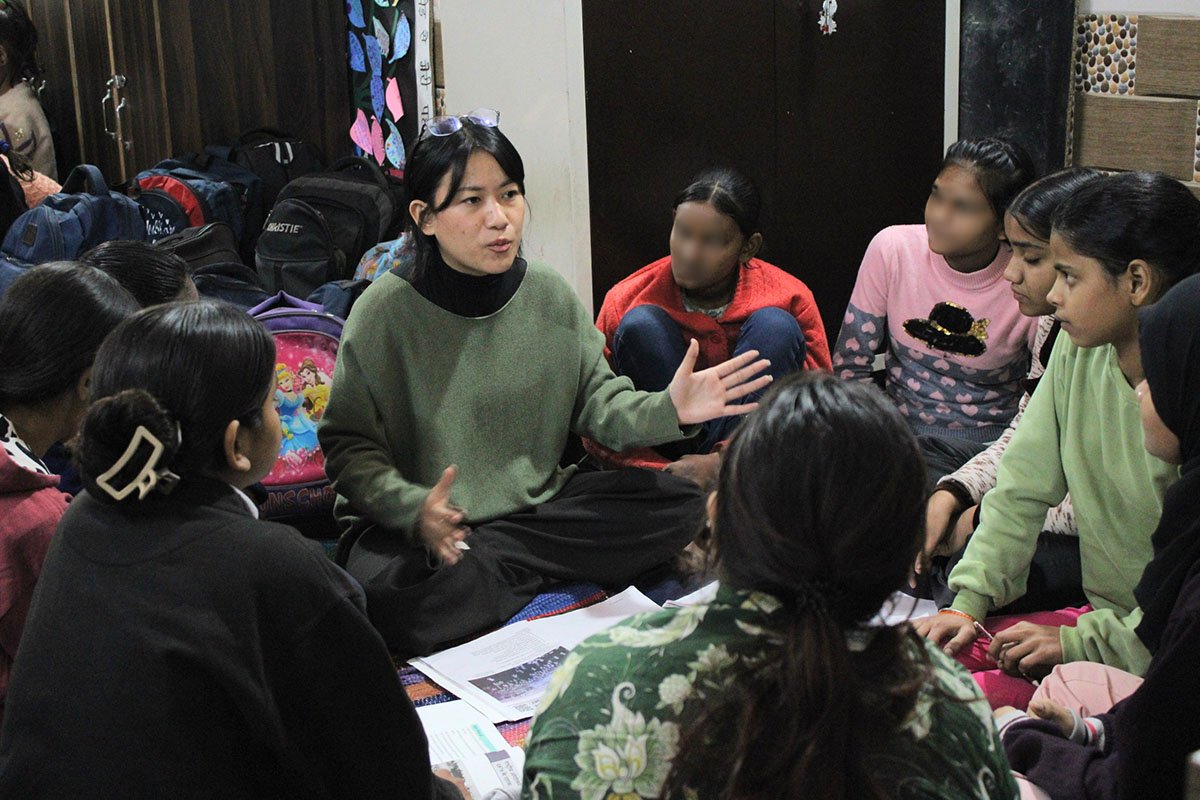
Author: Mapani Lamgu, Mapani Lamgu is an MA Development Studies intern from the Delhi School of Social Work at Protsahan India Foundation, Spring 2026.
An unexpected beginning
Just one day before our Semester II fieldwork was to begin, my co-intern and I learned that we had been reassigned to a new organisation: Protsahan India Foundation. The change was sudden, the brief unclear, and our expectations modest — we hoped, simply, for a fieldwork that would teach us something honest about the work.
On 02 February 2026, we walked into the office for the first time and met our supervisor. In the span of a single conversation, she set the tone, as much through induction slides and organisational charts, as much as the way she spoke about the girls, the communities, and the slow patience that this work demands. The vocabulary was unfamiliar to us as students still being trained: trauma-informed, community-led, dignity-first. What stood out was the absence of jargon-as-performance. The words meant something here.
Protsahan works at the grassroots with adolescent girls and young women in Delhi’s urban slum communities, through Girls Empowerment Centres (GECs), community dialogues, and Youth Peer Leaders who carry the work from inside the basti, not in spite of it. The model rests on participation, dignity, and the slow construction of community leadership. The name itself — Protsahan, encouragement — gestures at something more careful than the standard NGO promise of “upliftment.” The interventions are not external rescue. They are conditions in which a girl’s own confidence has room to grow.
The first day at GEC03
I remember the walk from the metro to the centre in Deepak Vihar slums more vividly than I expected to. The restlessness, the wondering why it was taking so long. As a woman from North-East with a face that reads as different in Delhi, and an accent that the city does not always meet kindly, the geography of an unfamiliar neighbourhood is never neutral. It carries weight. Even before fieldwork begins, the body is already learning the lesson.
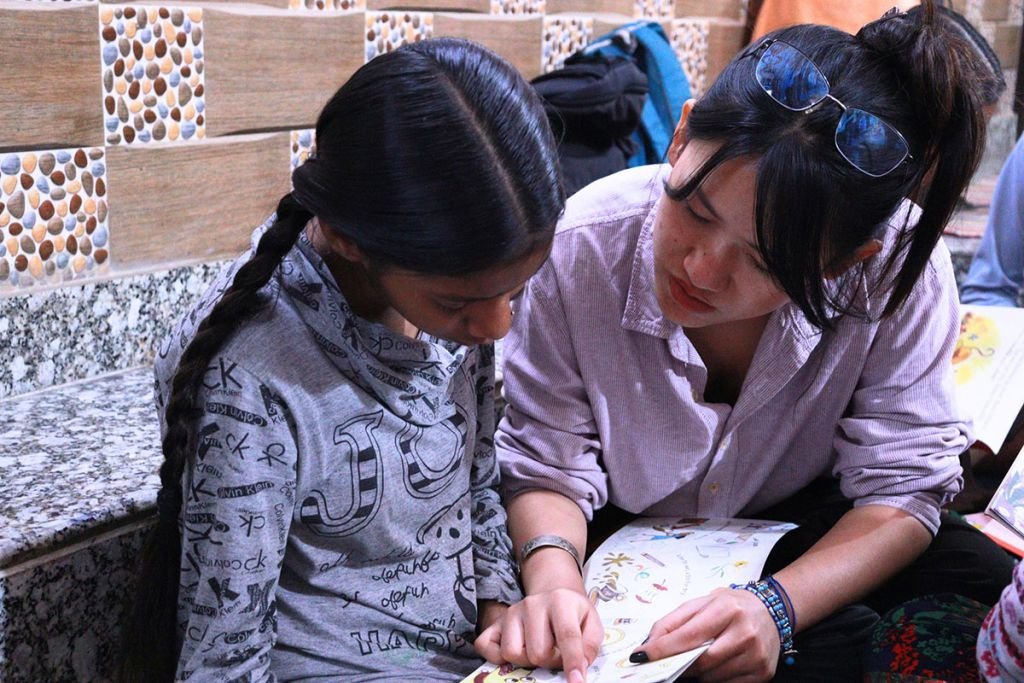
At the centre, we were briefed by the coordinators, executives, and Youth Peer Leaders on the daily rhythm of the GEC. Our brief was very clear yet twofold: support documentation, and help the girls with English and social studies. We spent the first half of the day reading the room. Around 1:30 in the afternoon, the girls began to arrive.
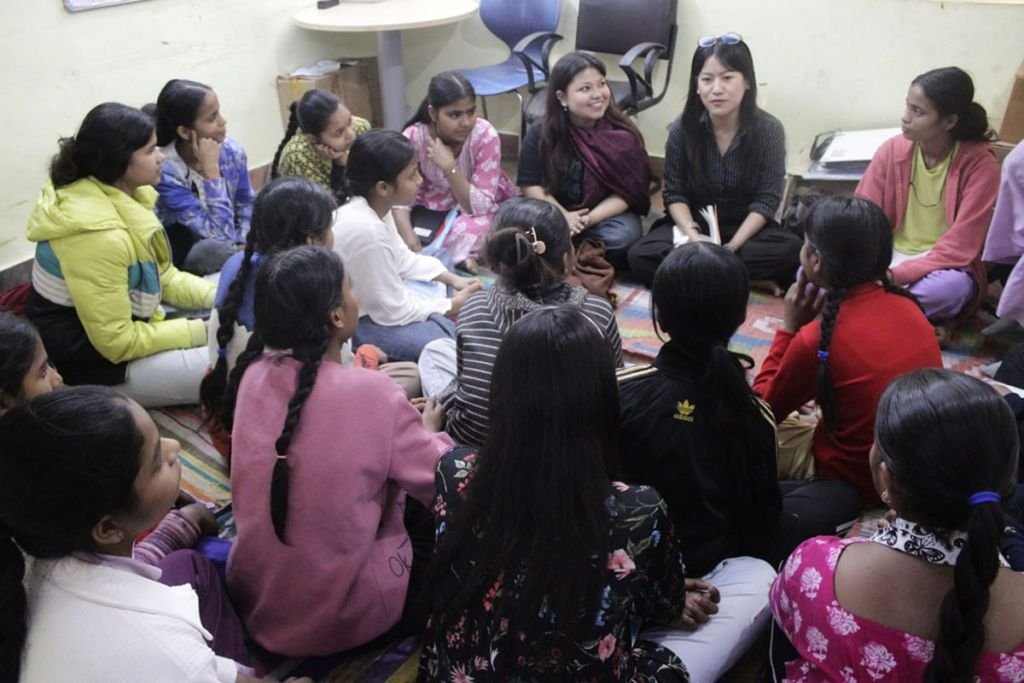
Despite seeing two unfamiliar faces, they were curious, not guarded. “Good afternoon, Didi!” — chirped without rehearsal, carrying the warmth that public spaces in this city rarely extend to women like me. We began with a circle of introductions: name, class, one favourite thing about yourself. A small ritual, but a deliberate one. In social work, rapport is not a soft skill. It is the precondition for everything that follows.
Then came the meditation session led by the centre coordinator — music therapy in practice. The girls bobbed their heads, lip-syncing softly to “Sapne re sapne re sapne mere…” It looked, on the surface, like a moment of leisure. But leisure is itself a feminist question. The right to rest, to stillness, to a few unhurried minutes that belong only to oneself — these are the precise things that women, and especially girls in households like these, are systematically deprived of by the unpaid, uncredited labour they shoulder. Watching them hum to a song felt, in that moment, like watching a small and quiet act of reclamation.
Pedagogy as solidarity
Over the following weeks, we shaped sessions around games and activities that smuggled confidence-building and capacity into things that simply looked like fun.
Gol-Gol turned arithmetic into a circle game: a player calls out a calculation, and the girls huddle into groups whose size matches the answer. 5–3=2 sends them scrambling into pairs. A dictation game placed one girl at the centre of the circle; she would pull a chit, shout the word three times, and the others wrote down the spelling. I Am Enough asked each girl to write three lines about herself in English — three sentences that, for many, were the first time they had been asked to describe themselves in their own voice rather than be described by someone else’s expectations.
We also rethought how we taught the academic syllabus. A textbook chapter is rarely just a textbook chapter, and a Class 8 history lesson on The Making of the National Movement opened a conversation I will keep returning to.
We had been discussing the freedom struggle, and I asked the girls a deceptively simple question: what does freedom mean in your own life? What followed was honest, and it was difficult. The everyday struggles came forward in plain language. Disproportionate housework. Mobility that ends at the gate. Choices made on their behalf, before they were old enough to know what choice felt like. The historical narrative of national independence began to mirror, uncomfortably and accurately, the quiet, ongoing negotiations these girls conduct every day for the smallest territories of selfhood.
This is what I think pedagogy in spaces like Protsahan is actually for. Not delivery of curriculum. Translation of curriculum into a girl’s own life — and then back outward, into the structures that shape it.
What the classroom revealed about the system
Honest reflection requires that I name the gaps too. Several students struggled with foundational concepts that the public education system was supposed to have built years earlier. The deficits were not theirs. They were inherited from a school system that has, in too many places, stopped teaching and started managing absences. I noticed too the way humanities and arts subjects were treated — by students, and sometimes by adults — as lesser cousins to science and mathematics. A reflection of a wider social tendency to undervalue the disciplines that build precisely the critical thinking and self-awareness our young people need most.
“Machines are made with purpose, but a human being is born with the freedom to discover it.”
Beyond the classroom, economic precarity ran underneath everything. Educational journeys interrupted by household earning needs, by migration cycles, by a younger sibling who needs looking after. This is where I came to understand why initiatives like Protsahan’s Community Dialogues matter. They are not add-ons to academic work. They are the work — because a girl’s right to learn cannot be sustained in isolation from the household and community conditions that govern her time, her safety, and her aspirations. These are conversations with the fathers, brothers and mothers of the girls in an emergence that is powerful yet difficult to name.
We participated in these outreach programmes at GEC01, GEC03 and GEC04 — sometimes as mobilisers, sometimes as facilitators, sometimes simply as observers learning how the moderator held the room. The high attendance of community women was both encouraging and revealing. It told us something about who is present in the basti during the day, who is absent, and how the gendered geography of paid and unpaid labour shapes who gets to participate in conversations about the girls’ own futures.
A module like the community dialogue carries within it a quiet theory of change. As organic leadership emerges from within the community, and as women themselves begin to set the agenda, the platform can gradually evolve into something community-owned. The NGO’s role becomes lighter, and eventually, the scaffolding can be withdrawn. This is what good development work looks like at its best — designed, from the start, to make itself unnecessary. These became my first lessons here.
Need-based sessions, and the limits of our own knowing
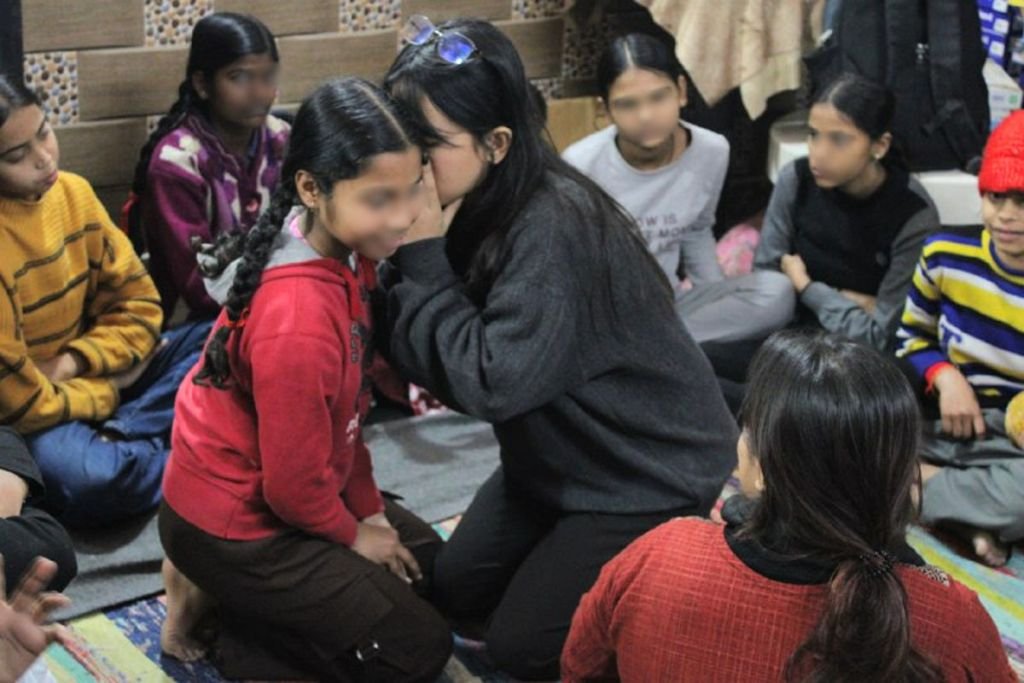
We also held need-based sessions — career guidance at GEC04, body positivity at GEC02. We chose, deliberately, not to deliver these as lectures. We opened the floor instead, and let the girls hold equal authorship of the conversation.
These sessions taught us as much as they taught anyone in the room. They asked us to examine our own privileges, our assumptions, the unconscious frames we had brought from our classrooms into theirs. As my co-intern said, in a sentence I have not stopped thinking about:
“Justice and survival do not move at the same pace.”
It is easy, when you have been schooled in the language of rights and frameworks, to mistake your own moral certainty for someone else’s lived possibility. The girls we worked with were not waiting to be told what justice looked like. They were calculating, every day, the cost of every step toward it, against the lived constraints of survival. Our job was to not flatten that calculation into a slogan.
A note from my own life
As a first-generation learner, this fieldwork did not stay at the level of the professional. It went somewhere more personal.
The journey toward economic freedom — the kind these girls are reaching for, the kind I have been reaching for — is also a journey of breaking the many barriers that systemic inequality has stacked into the path. Institutional. Cultural. Social. Political. Each small step in education and self-knowledge is also a small refusal of those structures. Not a triumph. A refusal. And refusals, sustained over time, are how cultures change.
For the Girl Champions
To the girls of GEC03, GEC01, GEC04 and GEC02 — thank you for the patience with which you taught us, the laughter you let us into, and the freedoms you are quietly building, day by day, for yourselves and for those who will come after you.
And the green grass grew, and the green grass grew all around.